Last updated: October 10, 2026
Key Takeaways
- An AI blog topic generator helps turn a rough seed into a usable set of angles; editorial judgment still matters.
- The right topic comes from intent, audience maturity, and format fit.
- One seed can become 20 ideas when you ask for different search jobs and filter hard.
- Good prompts say what to avoid as clearly as what to produce.
If you need an AI blog topic generator, the real problem is not “How do I get ideas?” It is “How do I turn one seed idea into article topics that fit my audience, my search intent, and my actual writing workload?” Quick answer: use an AI blog topic generator to widen one seed into 15-20 article ideas, then narrow them by intent, audience, and format. A good generator helps with that. A bad one spits out trendy nonsense and leaves you with a calendar full of dead drafts.
What an AI blog topic generator is actually for

An AI blog topic generator is for turning a rough seed into a usable list of article angles, not for replacing editorial judgment. If your seed is “email marketing,” the tool should help you break that into specific jobs: beginner guides, comparison posts, troubleshooting posts, and bottom-of-funnel pages. If your seed is already a full topic like “how to segment a list in Mailchimp,” then the tool should widen it into related questions, objections, and formats.
That distinction matters because the same AI output can be excellent or useless depending on the job. If you need broad coverage for a content plan, you want many adjacent ideas and some clustering by theme. If you need one article by Friday, you want a single angle with a sharp promise, not 40 near-duplicates.
I would use an AI topic generator when I have:
- one seed keyword and no angle
- a product feature that needs educational content around it
- a category page that needs supporting posts
- a stale content calendar that needs fresh subtopics
I would not use it as a replacement for audience research. If you already know the exact question your reader is asking, a generator should refine that question, not invent a new strategy. According to the Content Marketing Institute, documented strategy and audience clarity matter more than raw idea volume. The best tools are the ones that produce enough breadth to choose from, then let you filter by search intent, funnel stage, and difficulty in practice.
Quick check: If your seed idea feels too broad, too thin, or too obvious, this is the right tool; if your brief is already specific and validated, you probably need outlining, not ideation.
What actually determines the right topic from one seed idea
The right topic comes from intent, audience maturity, and format fit. If you ignore those three, the generator will still give you ideas, but most of them will miss.
If the reader is early-stage, then the article needs to explain terms, compare options, or show examples. A seed like “AI writing tools” could become “How to choose an AI writing tool for blog drafts” or “AI writing tools for solo marketers: what matters and what doesn’t.” If the reader is closer to buying, the same seed should shift toward evaluation: “ChatGPT vs Claude for first-draft blog outlines,” or “What to look for in an AI blog topic generator before you pay for one.”
The format matters too. A list post, a how-to, a comparison, and a troubleshooting guide do different jobs. The same seed “content gaps” can become:
- “How to find content gaps with Ahrefs or Semrush”
- “10 content gap examples your blog probably misses”
- “Content gap analysis: when it helps and when it wastes time”
Here is a simple way to sort generated ideas:
| Situation | Best Path | Why Other Options Fail |
|---|---|---|
| One seed, no audience clarity | Generate 20-30 subtopics, then sort by reader stage | Jumping straight to a title locks you into the wrong angle |
| One seed, known buyer intent | Generate comparison and decision-focused topics | Generic “what is” posts attract the wrong reader |
| One seed, stale blog archive | Generate adjacent questions and update candidates | Random trend ideas do not repair topical gaps |
| One seed, new site with no authority | Choose narrow, long-tail topics | Broad head terms usually outrank a new site |
If you are using ChatGPT, Claude, Gemini, Jasper, or a dedicated content tool, the same rule applies: the model can brainstorm, but you still have to decide what kind of reader the article is for. I would treat the AI as a sorting machine, not a strategist. The Nielsen Norman Group recommends designing content around user needs, not around the tool that produced it.
Quick check: If your best topic idea depends on who the reader is and what they are trying to do, you need intent-led generation, not a random list.
How do I turn one seed idea into 20 article ideas?

You turn one seed idea into 20 article ideas by asking the AI to expand in specific directions, then forcing each idea into a different search job. If you just say “give me blog ideas about SEO,” you will get junk. If you specify audience, intent, and format, you get usable material.
Use a five-step path like this:
- Write the seed in one plain sentence, such as “AI blog topic generator for small marketing teams.”
- Add one audience constraint, like “solo founder,” “agency writer,” or “B2B content manager.”
- Add one intent filter: educate, compare, troubleshoot, or buy.
- Ask for 20 ideas split across formats: how-to, list, comparison, mistake, template, and checklist.
- Sort the results into three buckets: publish now, refine later, and ignore.
- Take the 3 best ideas and ask the AI to create subheadings, not more titles.
A prompt that can work better than “give me ideas” looks like this:
- Seed: AI blog topic generator
- Audience: content marketers at small SaaS companies
- Goal: ideas that attract search traffic and lead to product consideration
- Output: 10 beginner, 10 comparison, 10 troubleshooting topics
- Constraint: avoid overlapping titles
The best ideas usually come from forcing contrast. For example:
- “Best AI blog topic generator tools for solo writers”
- “How to use an AI topic generator without creating generic content”
- “AI topic generator prompts that produce long-tail article ideas”
- “When an AI topic generator is the wrong tool”
Notice the last one. A generic article leaves out the negative case. That is a mistake because the negative case filters out bad traffic and sharpens the reader’s decision.
If the AI starts repeating itself, change the lens:
- from feature to outcome
- from beginner to advanced
- from tool to workflow
- from tool comparison to use case
- from search traffic to conversion
One good seed can produce 20 usable ideas, but not 20 useful titles in one pass. I would rather get 8 sharp angles than 30 recycled ones.
Quick check: If your current prompts keep producing the same five title patterns, you need stronger filters, not a different model.
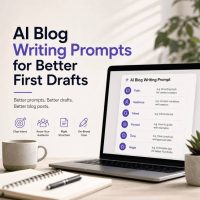
What good prompts look like in practice
Good prompts tell the AI what to avoid as clearly as what to produce. If the prompt does not include audience, format, and exclusion rules, the output will drift toward vague, high-volume nonsense.
Here are three prompt patterns I would actually use.
First, the expansion prompt:
– “Take the seed idea ‘AI blog topic generator’ and create 15 article ideas for B2B content marketers. Split them into beginner, comparison, and troubleshooting topics. Avoid duplicate angles and avoid overly broad titles.”
Second, the editorial prompt:
– “From this seed, generate ideas that are specific enough to publish on a blog with a small domain authority. Prefer long-tail topics, practical examples, and decision-making angles over broad definitions.”
Third, the refinement prompt:
– “Pick the 5 strongest ideas from this list and rewrite them as titles with clearer reader intent, stronger verbs, and one specific outcome each.”
If you are using a tool like ChatGPT, Claude, or Gemini, I would also add guardrails:
- “Do not repeat the seed phrase in every title.”
- “Do not create listicles only.”
- “Include one contrarian idea.”
- “Include one topic for readers who are not ready to buy.”
This matters because topic generation is not the same as ideation soup. A tool can easily give you 15 versions of the same article. A useful workflow gives you variety: one educational guide, one comparison piece, one template, one mistake post, one decision guide.
The honest trade-off is time. A better prompt takes longer to write, and a better review takes longer to do. But that time is cheaper than drafting eight weak articles and discovering, too late, that none of them satisfy a real search need. According to Google Search Central, useful pages should serve a clear purpose and satisfy the searcher, not just fill space.
If you are choosing between a dedicated AI blog topic generator and a general model, I would pick the general model when you need flexibility and the dedicated tool when you need a faster, narrower workflow. The general model is better at unusual angles. The dedicated tool is often better at volume and repeatability.
Quick check: If the ideas sound smart but not publishable, your prompt is too open and your constraints are too weak.
When the standard advice is wrong
The standard advice is wrong when you already know the content problem is not ideation. If the issue is distribution, sales alignment, or stale site architecture, more topic ideas will just create more noise.
If you are writing for a new site with little authority, then “target high-volume keywords” is bad advice. A seed like “AI blog topic generator” should branch into low-competition, specific posts first, such as workflow guides, comparisons, and use-case pages. Broad head terms are usually a long wait. I would choose narrower terms until the site earns trust.
If you are running a product-led blog, then pure informational topics are incomplete. The generator should also produce buyer-support content:
– “How to choose an AI blog topic generator”
– “AI topic generator features that matter for teams”
– “How to build a blog calendar with AI”
Those topics sit closer to product evaluation and are often more valuable than generic “what is AI” posts.
If your brand has strong opinions, then neutral topic generation is too bland. Seed ideas should be pushed toward stance:
- what you prefer
- what you reject
- what trade-offs you accept
- where the common advice breaks
That is where the article gets useful.
If you are using the output for a content brief, then the generator should produce not just titles but angles, objections, and supporting questions. A title alone is not enough. You need the questions the article must answer in order to feel complete.
Quick check: If your traffic problem is really a positioning problem, topic generation alone will not fix it.
Edge cases where normal advice breaks down
The normal advice breaks down in a few predictable cases. When it does, the fix is specific.
-
If the seed idea is too vague
What changes: the AI has no boundary, so it returns generic filler.
What to do instead: add a target reader, a use case, and one content format. Turn “AI content” into “AI blog topic generator for solo SaaS founders.” -
If the seed idea is too narrow
What changes: the generator runs out of angles fast.
What to do instead: widen one layer up. Turn “AI blog topic generator for HubSpot” into “AI topic generation for marketing ops workflows.” -
If the topic is regulated or technical
What changes: accuracy matters more than novelty.
What to do instead: use the AI only to surface questions, then verify with authoritative sources such as the official Google Search Central documentation, the Content Marketing Institute, or the Nielsen Norman Group. -
If the site is already saturated with similar articles
What changes: duplication becomes the main risk.
What to do instead: ask for non-overlapping angles, then map each idea to a different intent. -
If the goal is sales, not traffic
What changes: “informational” topics are not enough.
What to do instead: bias toward comparison, alternatives, and evaluation articles. -
If the audience is expert-level
What changes: beginner titles will underperform.
What to do instead: ask for advanced workflows, failure modes, and edge cases.
Quick check: If your first batch of ideas feels safe but forgettable, one of these edge cases is probably the reason.
What a usable workflow looks like from seed to publishable idea
A usable workflow starts with one seed and ends with one title that survives scrutiny. If you skip the middle, you get a pile of notes instead of a publishable plan.
Use this path:
- Start with one seed phrase, such as “AI blog topic generator.”
- Define the reader in one line: beginner blogger, SaaS marketer, agency writer, or solopreneur.
- Choose the job: learn, compare, troubleshoot, or buy.
- Ask the AI for 15 to 20 ideas across at least 3 formats.
- Remove anything that overlaps, sounds generic, or lacks a clear reader need.
- Pick one topic and ask for the search intent, angle, outline, and objections.
- Check whether the idea is worth writing before you draft a single paragraph.
I would call this the simplest sane workflow because it forces a decision at every step. It also keeps the AI in the role it does best: expanding and sorting. The human job is choosing.
That choice is what generic articles miss. They treat topic generation like a magic box. It is not. It is a filter for turning messy seeds into article topics you can actually publish, rank, and maintain.
If you want the safest first article, choose a long-tail how-to, but treat that as a starting point, not a guarantee. If you want the strongest commercial article, choose a comparison or selection guide. If you want the most durable archive piece, choose a workflow or troubleshooting topic. I would not start with a broad definition article unless the site is brand new and needs a simple anchor.
Quick check: If you can point to the reader, the job, and the format in one sentence, you have a topic worth drafting.
FAQ
What is the best AI blog topic generator for beginners?
The best choice for beginners is the tool that helps you create specific, non-overlapping ideas quickly. For beginners, I would favor a general model like ChatGPT or Claude because it is easier to steer with prompts. A dedicated tool can be fine if you want speed, but it is only useful when you already know what you want to generate.
Drafted with AI; not yet reviewed by a person.